
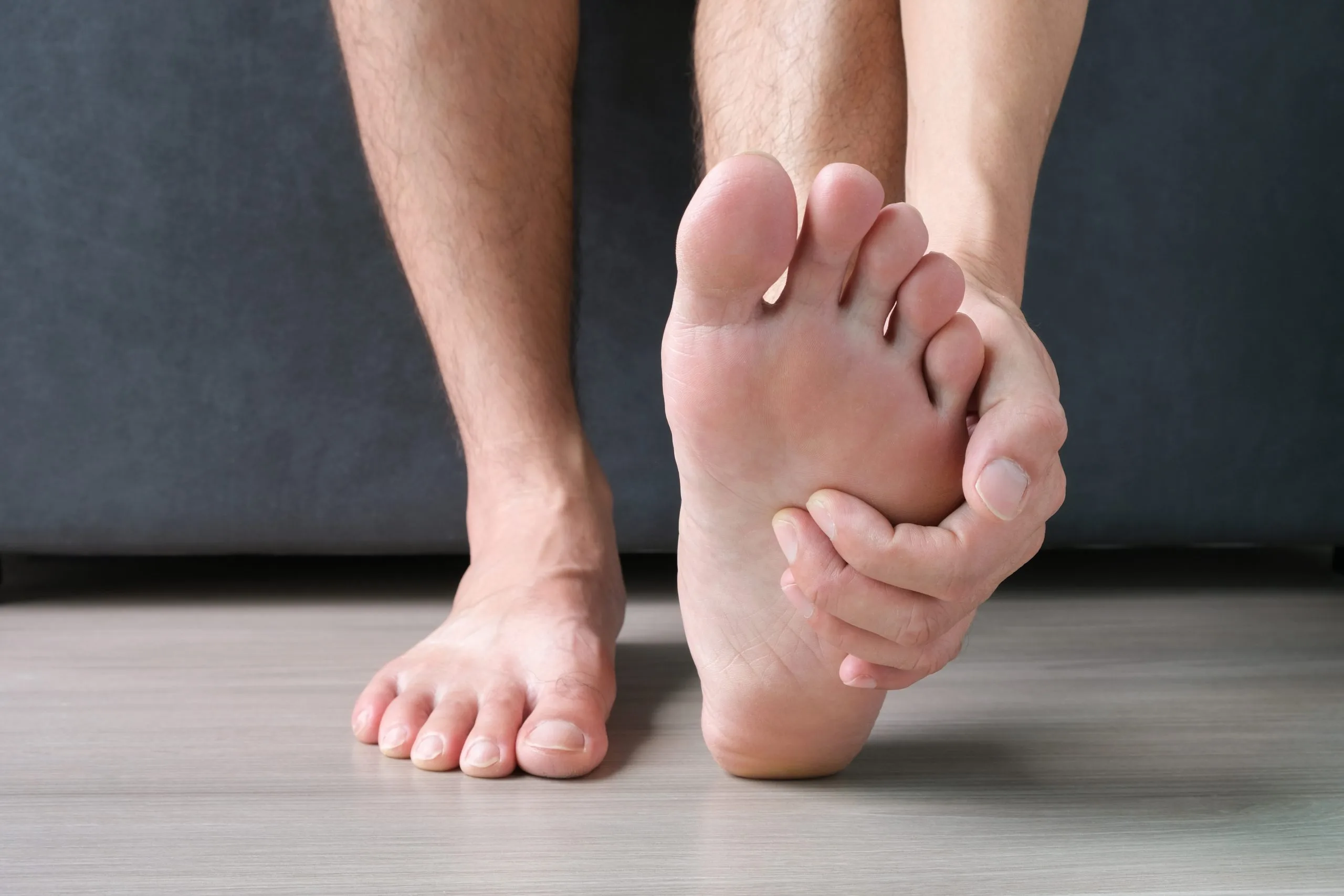
If you’ve ever hopped out of bed and felt that first step land like a knife in your heel, you already know why this question matters so much. Plantar fasciitis pain has a way of shrinking your world – skipping morning walks, dreading the school run, avoiding the gym you used to love. When patients ask us which injection works better, cortisone or platelet-rich plasma (PRP), the honest answer is that it depends on how long you’ve been hurting and what you’re hoping to fix.
Cortisone tends to work faster for short-term relief, while PRP tends to work better for lasting healing in cases that have dragged on. Neither one is automatically “better” – the right choice depends on your specific case, which is exactly what a proper plantar fasciitis evaluation is designed to figure out.
Heel pain from plantar fasciitis is one of the most common reasons people come to our office. It’s stubborn, it’s frustrating, and it doesn’t always respond to rest, stretching, or a new pair of sneakers. Once conservative care stops moving the needle, injections become the next logical step – and that’s when the cortisone-versus-PRP question starts.
Both are injected into or near the plantar fascia, the thick band of tissue that runs along the bottom of your foot. Both aim to calm inflammation and get you back on your feet. But they work in almost opposite ways, and understanding that difference changes how you should think about your own recovery.
Cortisone is a corticosteroid, a powerful anti-inflammatory medication. When injected into the heel, it reduces swelling and pain quickly, often within a few days.
Fast-acting relief, sometimes noticeable within 24 to 72 hours
Effective for short bursts of severe pain
Good option before a big event, trip, or deadline where you need quick mobility
Relief typically lasts weeks to a few months, not permanently
“Cortisone has its place, and I still use it regularly,” says Dr. Ashot Oganesyan, foot and ankle specialist at Revive Hand and Foot Institute. “It’s excellent at breaking a painful cycle so a patient can start physical therapy or stretching again. What I always tell patients is that it treats the inflammation, not the underlying tissue damage.”
That distinction matters. Repeated cortisone injections into the same spot can, over time, weaken the plantar fascia and the fat pad that cushions your heel. Most podiatrists, including our own, limit how often it’s used in the same area for exactly that reason.
Platelet-rich plasma takes a different approach entirely. A small sample of your own blood is drawn, centrifuged to concentrate platelets and growth factors, and then injected directly into the damaged fascia. Instead of masking inflammation, PRP is meant to stimulate your body’s own repair process.
Uses your own blood, so there’s no risk of an allergic reaction to the injected material
Targets the root cause of degeneration, not just the pain signal
Results build gradually over several weeks to a few months
Often recommended after cortisone or physical therapy hasn’t provided lasting relief
“PRP isn’t a quick fix, and I’m always upfront about that,” Dr. Oganesyan explains. “Patients sometimes come in expecting to feel better the next morning. What I’ve seen in my own practice is that the real improvement shows up around the six to eight-week mark, as the tissue actually starts to remodel itself.”

Here’s a bit of foot trivia you might find interesting.
Your plantar fascia handles roughly 1.5 to 2 times your body weight with every single step. Over the course of an average day of walking, that tissue is absorbing well over a million pounds of cumulative force.
Cortisone shares its chemical roots with cortisol, the hormone your adrenal glands already release when you’re stressed. Injected cortisone is essentially a concentrated, targeted version of something your body produces naturally every day.
Plantar fasciitis pain is often worst first thing in the morning because the fascia tightens overnight and is suddenly stretched the moment you take your first step. It’s not really “damage happening” in that instant – it’s more like waking up a tissue that fell asleep tense.
There’s no universal winner between these two treatments, and any provider who tells you otherwise is oversimplifying. A few factors tend to guide the decision:
Pain that’s been around for a few weeks often responds well to cortisone paired with stretching and supportive footwear. Pain that’s lingered for six months or longer, despite trying rest, orthotics, and physical therapy, tends to respond better to PRP, since the tissue itself may have started to degenerate rather than just become inflamed.
Athletes and highly active patients often lean toward PRP because it addresses tissue quality rather than temporarily numbing pain, which matters if you’re planning to return to high-impact training. Someone managing a flare-up around a wedding or a work trip might reasonably choose cortisone for the quick turnaround.
“If a patient has already had two or three cortisone shots without lasting improvement, that’s usually my cue to talk about PRP,” says Dr. Oganesyan. “At that point, more cortisone is unlikely to solve the underlying problem, and it starts to carry more risk than benefit.”
Neither cortisone nor PRP works in isolation. At Revive Hand and Foot Institute, injections are almost always paired with other elements of a complete plan, such as custom orthotics to correct the mechanical stress on your arch, MLS laser and shockwave therapy to support tissue healing between injections, and a structured stretching or physical therapy routine.
“I never want a patient to think of an injection as the whole solution,” Dr. Oganesyan notes. “It’s one part of a plan. If we don’t also address footwear, foot mechanics, and daily habits, the pain tends to come back no matter which injection we use.”
In the rare cases where injections and conservative care haven’t resolved chronic plantar fasciitis after many months, surgical options may be discussed, though this is typically a last resort.
Both treatments are considered low risk when performed by an experienced provider, but they have different profiles.
Cortisone: rare risk of fat pad thinning, skin discoloration, or plantar fascia rupture with repeated use in the same site
PRP: minimal risk since it uses your own blood, though mild soreness at the injection site for a few days is common
Neither should be treated as a casual, walk-in decision. A proper diagnosis, sometimes including imaging, helps rule out other causes of heel pain – like a stress fracture or nerve entrapment – that wouldn’t respond to either injection.
If you need relief fast and your case is relatively new, cortisone is a reasonable, well-studied option. If you’ve been dealing with heel pain for months, tried the basics, and want to address the tissue damage rather than just quiet it down, PRP is often the more durable choice. Many patients end up trying one, learning from how their body responds, and then moving to the other.
“What matters most isn’t which injection is trendier right now,” Dr. Oganesyan says. “It’s matching the right tool to the right stage of your condition. That’s a conversation, not a guess.”
If heel pain has been slowing you down, the next step is a proper evaluation rather than guessing between treatments on your own. You can schedule a consultation to have your case assessed directly, and our team can also walk you through what your insurance may cover for either option.
Disclaimer: This article is for general informational purposes only and does not constitute medical advice. It is not a substitute for a professional diagnosis or treatment plan from a licensed healthcare provider. Every case of plantar fasciitis is different, and treatment recommendations should always be based on an individual evaluation. If you are experiencing heel or foot pain, please consult a qualified podiatrist or physician before starting or changing any treatment.